
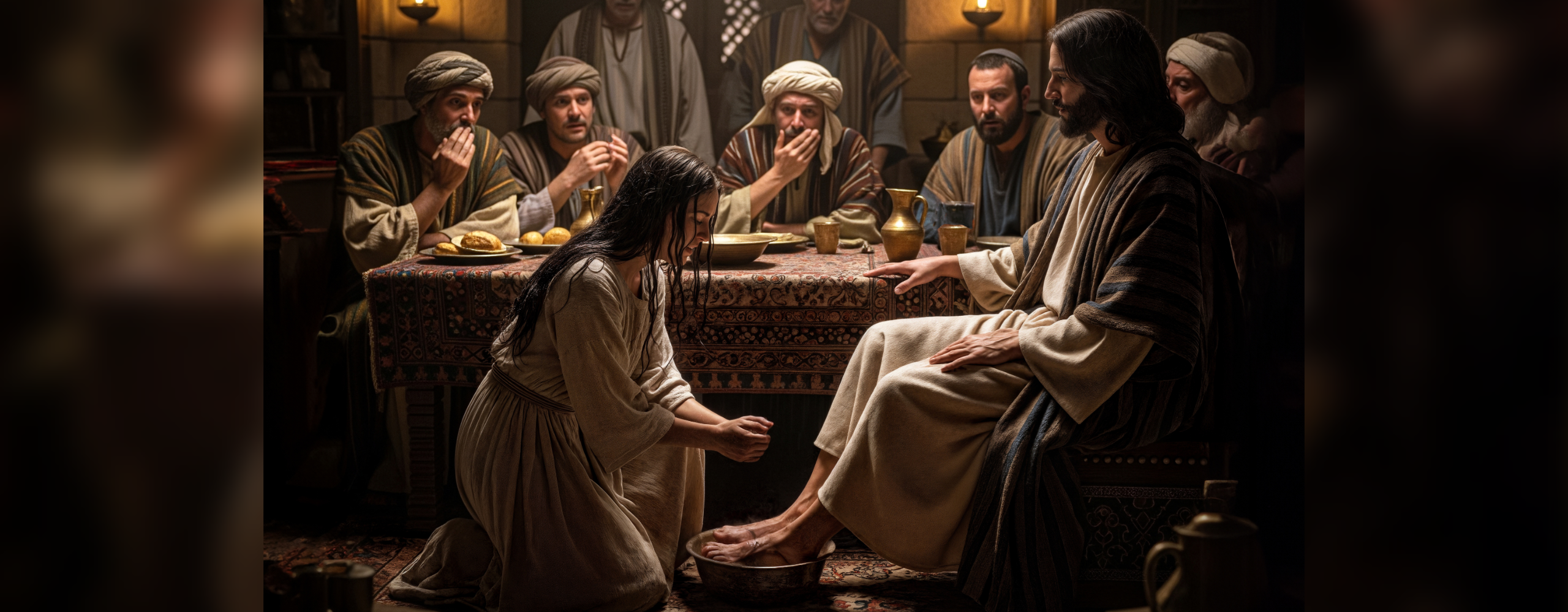
I remember being in a strip club on outreach when one of the dancers asked me, “Who is Jesus anyway?” Then she added, “Jesus was Catholic, right?”
There was something unexpectedly sincere and endearing about the question. I told her, “Catholicism came after Jesus, so no, He wasn’t Catholic. But I can tell you who He is.”
From Genesis to Revelation we see Him, and He is matchless and radically different.
Jesus Was Different
Jesus was radical. Not because He chased power, influence, or spectacle, but because He quietly overturned the systems people trusted most. He moved differently than religious leaders expected. He gave dignity to people society minimised. He challenged hierarchy and perhaps most revolutionary of all, He revealed that God looked nothing like the powerful men who claimed to speak for Him.
The Pharisees struggled with Jesus because He disrupted the structure that gave them certainty. Their faith had become deeply tied to status, public image, legalism, and control. Jesus exposed how easy it is to appear righteous while remaining spiritually distant from compassion, humility, and love. (Matthew 15:8,9) He didn’t reject the Law, He fulfilled it by bringing people back to its heart.
And if we’re honest, the same tension has always existed in the church in different forms.
If you’ve lived a while, you probably remember a time when church didn’t always feel as welcoming as we said it was. We said everyone was welcome, but I still remember what it looked like when someone walked in who didn’t fit the culture. People would stare, and sometimes they would even comment.
I remember once, as a pastor, deciding to wear pants instead of a dress on a Sunday night. Not long afterward, a mom approached me and asked, “What will I say to my girls now?” That moment has stayed with me because it revealed something deeper than a conversation about clothing. It highlighted how easily we can elevate outward appearance and attach spiritual significance to things God never intended to carry that weight. I’m sure her motives were sincere. She wanted to honour God and model what she believed was right. But somewhere along the way, certain expectations about clothing in church had been given far more importance than they deserved.
The reality is that God’s house isn’t a building. God’s house is His people. The same people wearing those clothes on Sunday are wearing them on Monday, Tuesday, and every other day of the week. The condition of a person’s heart isn’t determined by whether they’re wearing jeans or a dress. Our faithfulness to God has never been found in a wardrobe. Jesus consistently looked beyond outward appearances and focused on what was happening within a person. That’s where real transformation takes place.
And if I’m honest, for some of you, this still happens today.
Not long ago, I had to speak to someone about commenting on a woman’s outfit that she personally didn’t approve of. What concerned me more wasn’t just the comment itself, but the pattern behind it. Was this happening regularly? Was she also forming opinions about people who don’t yet know Jesus, based on outward appearance? People with tattoos or brightly coloured hair, still get stares from some and comments from others. I’ve had more than one mom tell me she felt concerned that her son was on stage wearing a baseball cap, or jeans playing in the band and I would respond with, “I’m pretty sure it’s okay with God, I’d rather he be wearing cap on stage then in a suit in the back row with his arms crossed and unengaged.”
This is exactly where Jesus confronted religious culture. He refused to measure people the way systems do. He looked past appearance, status, and assumption, and He restored dignity where others had already made judgments.
I Samuel 16:7 “But the Lord said to Samuel, “Do not look on his appearance or on the height of his stature, because I have rejected him. For the Lord sees not as man sees: man looks on the outward appearance, but the Lord looks on the heart.”
The question for us is simple. Are we building something that reflects His heart, or just repeating the patterns He came to disrupt?
He Chose Mercy
Again and again, Jesus chose mercy over performance.
While religious leaders protected appearances, Jesus touched lepers. He sat with tax collectors. He defended women publicly. He spoke with Samaritans. He healed on the Sabbath. He let children interrupt Him. He welcomed the poor, the grieving, and the socially rejected into spaces religion had pushed them out of.
That made Him dangerous to the religious establishment. It makes Him amazing to me.
He Wasn’t Interested In Self Promotion
Jesus never needed to dominate a room with His voice and self promotion. He often withdrew from crowds instead of building momentum around Himself. Can you imagine Jesus telling the world He was the best and there has never been another Saviour like Him? Of course there has never been anyone like Him, but He would never say that. After miracles, He regularly told people not to make Him famous. He carried Himself with unusual restraint. He taught in stories, listened carefully, moved slowly, and spoke with authority.
Even His entry into Jerusalem rejected spectacle. Kings arrived on war horses. Jesus came on a donkey. That’s radical.
The Pharisees expected a Messiah who would reinforce power structures or overthrow Rome through force. Instead, Jesus confronted spiritual pride first. He warned that people could know Scripture deeply yet completely miss the heart of God. That frightened religious leaders because it meant proximity to religion was not the same thing as transformation.
He Gave Dignity to Women
One of the clearest ways Jesus challenged culture was through the dignity He gave women.
In the ancient world, women’s voices were often dismissed socially and legally. Yet throughout the Gospels, Jesus consistently treated women as spiritually intelligent, worthy, trustworthy, and fully human in ways that broke cultural expectations.
He taught Mary of Bethany (Luke 10:38–42) He defended the woman accused of adultery (John 7) when religious leaders wanted public condemnation. He spoke openly with the Samaritan woman (Luke 4) at the well something many Jewish men, especially teachers, would have avoided entirely. Not only did He speak to her, He entrusted her with truth about worship and identity, and she became one of the first evangelists to her town.
And then came the resurrection.
While others hid in fear, women stayed. At the cross. At the tomb. At the first light of resurrection. Mary Magdalene, Salome, and Mary the mother of James didn’t just witness the Gospel, they carried it first.
For too long, some faith traditions have acted like women’s voices were secondary, when Jesus Himself trusted them with the greatest news the world would ever hear.
Mary Magdalene was the first to hear the risen Christ speak her name. The first to be sent.
The first to proclaim resurrection.
“Go and tell my brothers…” John 20:17
Jesus didn’t wait for permission from systems or hierarchy. He revealed resurrection through voices society overlooked. That’s not rebellion. That’s redemption.
This is part of why the religious establishment struggled so deeply with Him. Jesus constantly revealed that God moved through unexpected people rather than approved platforms. Holiness was no longer about proximity to power it was about love, humility, truth, mercy, and surrender.
He challenged being clean by touching the “unclean.”
He challenged patriarchy by honouring women.
He challenged wealth by blessing the poor.
He challenged religious ego by elevating children.
He challenged violence by teaching forgiveness.
He challenged domination by washing feet.
And He did all of it without trying to impress people.
The Way of Jesus
Modern culture often imagines power through visibility, branding, outrage, or control. Jesus showed another way entirely. His authority came through presence, not performance. Through sacrifice, not self-protection. Through surrender, not image management.
Even at His trial, when false accusations surrounded Him, Jesus often remained silent. That silence was not weakness; it was restraint. He didn’t need to win arguments to embody truth.
The cross itself looked like failure to almost everyone watching. But resurrection revealed that love is stronger than empire, stronger than fear, stronger than religious control, and stronger than death itself.
Jesus was radical because He refused to become what the world expected power to look like.
God help us to follow His example.
Leave a Reply